
4. Blending by Restart Merger
In a rebirth or restart merger
the blending churches intentionally die in order to start a new
congregation with a new up-to-date name, a renewed sense of mission,
and a new public identify. Reborn congregations usually carry on
some of the cherished traditions of their predecessors and they
provide a place of fellowship and caring for their long term
members. Their emphasis, however, is on a fresh start that
will reach and serve people in the community in a renewed ministry.
Some of the marks of a Rebirth merger include:
·
A vision to engage with the community
·
An up-to-date name, graphics and signage to present a fresh face to
the community
·
Worship that appeals to neighbors and meaningful to everyone
·
A frank understanding of the habits and customs of the previous
churches that kept them stuck
·
A new or remodeled facility
Case Study:
Living Spirit United Methodist in Minneapolis
Ashbury and Oakland Avenue United Methodist Churches were just over
a mile apart in south Minneapolis but each had a unique identity.
Ashbury was a traditional mostly white Methodist church with strong
fellowship and a commitment to social justice. Oakland Avenue was
located in the first neighborhood in south Minneapolis to integrate
and Oakland Avenue became one of the rare protestant churches that
was genuinely multiracial. By 2005, however, both churches were
facing financial struggles, building maintenance issues, and a slow
loss of members. 
.JPG)
Over the years the congregations shared programs like confirmation
and VBS, and in 2008 they started meeting and occasionally
worshiping together. This led naturally to conversations about
merger, but with
skepticism because of the differences in identity. Oakland Avenue
worked hard to be multiracial and didn’t want that effort diluted by
a merger. After heartfelt and honest meetings the congregations
agreed on a mutual commitment to being multiracial and to social
justice. In 2010 they merged, intentionally forming a new
congregation, Living Spirit, out of the strengths of both churches.
The new congregation moved into one of the buildings and sold the
other. Since then their commitment has born fruit in terms of new
people, multiracial membership and community engagement for social
justice.
Dave Raymond of ChurchFuture was a co-consultant to Asbury and
Oakland as they put together this restart.
Case Study: New Hope Lutheran in El Paso, Texas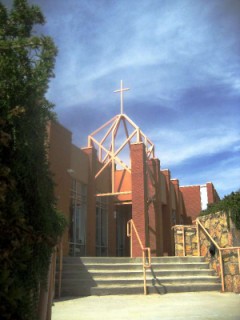
In August of 1999 St. John's and Good Shepherd Lutheran Churches in El Paso dissolved in order to give birth to New Hope Lutheran. New Hope used the proceeds from the sale of one predecessor church to build a new sanctuary at the other site. At the same time the church experienced pastoral turnover. In 2000 average attendance was 84, a drop from the combined attendance before consolidation. After that attendance grew by 50% while population grew by 2.5% in New Hope's zip code. Ten of the 36 people who joined new Hope in 2007 were previously unchurched.
Articles about Two Recent Consolidations Coached by Dave Raymond
Harbor of Grace in Muskegon, Michigan
Vista Lutheran Church in St. Louis Park, Minnesota
Track Record of Rebirth Mergers
The chart on the Continuation Merger page shows that Rebirth
Mergers tend to have a good track record, especially when compared
to the status of the congregations just before merger.
Why is this? An intentional rebirth and transformation motivates
the congregation to rethink and reinvent its ministry to be more
responsive to the needs of the community. Through rebirth the
churches present a new name and a new image to their neighbors. The
transformed church is often able to build or remodel a building that
is more functional, inviting, and environmentally friendly. The new
church no longer has to operate on the principle that "we've always
done it this way". This reinvention can change the direction of the
church's life cycle from decline to growth.